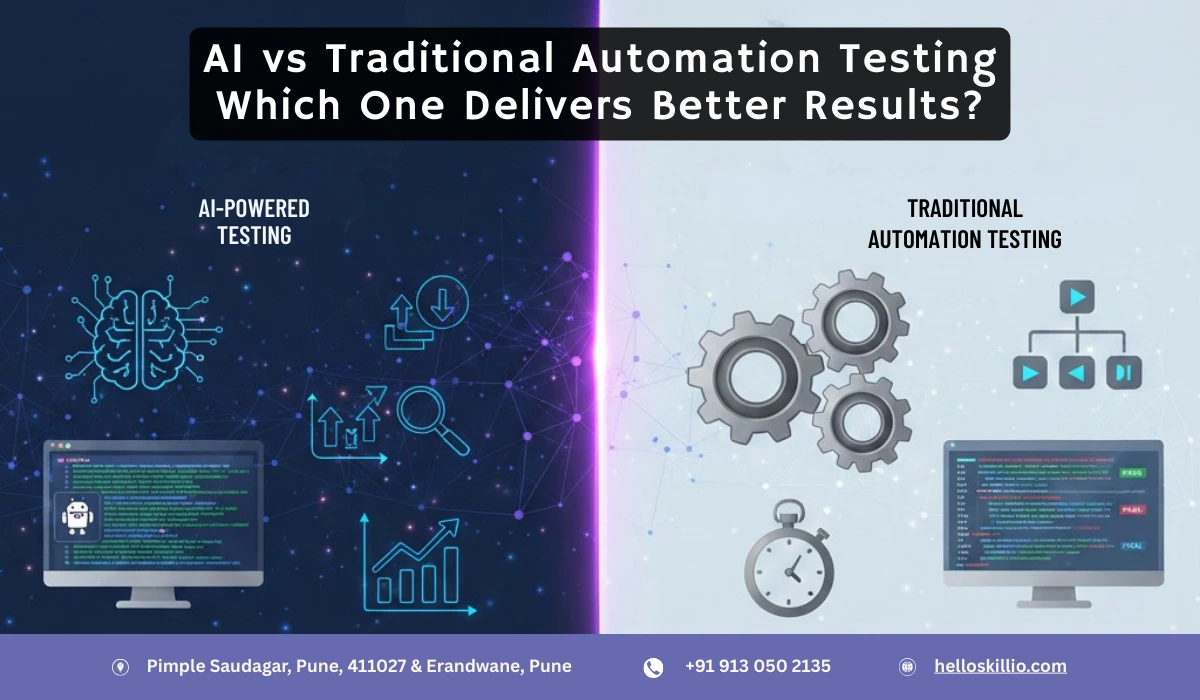
The software testing landscape has undergone multiple transformations over the last decade. From fully manual testing to script-based automation and now to AI-powered automation, the evolution has been fast and impactful. As organizations move toward rapid releases, continuous deployment, and complex digital experiences, the need for smarter and faster testing has never been greater. Many professionals are now upgrading their skills through an AI Automation testing course in Pune to stay aligned with the future of quality engineering.
This shift raises a crucial question:
Which approach produces better results — traditional automation testing or AI-driven automation testing?
To answer this, let’s examine how both methods compare in accuracy, speed, scalability, cost efficiency, and long-term business value.
Understanding Traditional Automation Testing
Traditional automation testing relies on scripts written manually by test engineers. These scripts execute predefined test cases using tools such as Selenium, Appium, QTP/UFT, Cucumber, and JMeter.
How Traditional Automation Works
- Testers identify the test scenario.
- Test scripts are manually written in programming languages like Java, Python, or JavaScript.
- The scripts are executed to validate expected outcomes.
- Whenever an application changes, the scripts must be updated manually.
Advantages of Traditional Automation
-
Reusable for repetitive tests: Ideal for regression testing as scripts can be executed repeatedly without extra effort.
-
Clear visibility of script logic: Transparent test logic makes debugging and review easier.
-
Mature ecosystem: Supports multiple tools, frameworks, and programming languages.
-
Skilled workforce availability: Widely taught and adopted, so trained testers are easily available.
Limitations of Traditional Automation
-
Scripts break with UI changes: Requires frequent manual updates and maintenance.
-
Time-consuming: Writing scripts for complex scenarios can take weeks or months.
-
Limited intelligence: Can only execute predefined scenarios and cannot predict new bugs.
-
Scaling issues: Increasing automation coverage requires additional manpower.
While traditional automation is reliable and structured, it struggles to meet the demands of modern Agile and DevOps environments.
Understanding AI-Powered Automation Testing
AI-powered automation leverages artificial intelligence and machine learning to improve test execution, maintenance, and decision-making. Instead of simply running scripts, AI assists in generating, optimizing, prioritizing, and maintaining test cases autonomously.
How AI-Powered Automation Works
AI is applied to:
- Automatically create test scripts based on product understanding
- Detect UI and logic changes and instantly heal broken test cases
- Predict high-risk modules based on past failures
- Prioritize test execution for faster release cycles
- Analyze results and identify root causes with minimal human intervention
Advantages of AI-Powered Automation
- Rapid test creation: Significantly reduces scripting effort by auto-generating tests.
- Self-healing capability: Adapts automatically to UI and logic changes, reducing maintenance.
- Higher test coverage: Efficiently covers UI, API, database, and workflow testing.
- Improved accuracy: Learns from patterns and improves reliability over time.
- Supports frequent releases: Ideal for Agile and CI/CD environments, enabling faster delivery.
Challenges
Limitations of AI-Powered Automation
- Higher tool cost: Advanced AI tools can be expensive compared to traditional frameworks.
- Skill upgrade needed: Testers must learn AI-assisted testing workflows.
- Cloud dependency: Most AI testing tools require cloud infrastructure to function optimally.
Despite the challenges, AI automation offers unmatched benefits in fast-changing development environments.
AI vs Traditional Automation — Key Comparison
|
Criteria |
Traditional Automation |
AI-Powered Automation |
|
Test Script Creation |
Manual | Autonomous |
|
Maintenance |
High | Very Low (self-healing) |
|
Accuracy |
Medium | High, improves continuously |
|
Coverage |
Limited by time | Extensive and optimized |
| Execution Speed | Moderate |
Extremely fast |
| Scalability | Resource dependent |
Easily scalable |
| Cost Over Time | High |
Lower due to reduced maintenance |
| Best Fit For | Stable and predictable applications |
Dynamic applications with frequent releases |
Real-World Scenarios — Which One Performs Better?
|
Testing Scenario |
Traditional Automation |
AI Automation |
| UI updates every sprint | Scripts frequently break | Self-heals and continues execution |
| Tight release deadlines | Limited capability | Capable of full regression within hours |
| Large microservice ecosystem | Hard to scale | Scales easily across services and devices |
| Predictive bug detection | Not possible | AI detects potential failure points |
| Cross-platform validation | Requires multiple scripts | Supports unified test automation |
In nearly every high-demand scenario, AI-powered testing demonstrates superior performance and efficiency.
Will AI Replace Traditional Automation Completely?
Not immediately — and not entirely.
Traditional automation still plays an important role in:
- Stable enterprise applications
- Long-term legacy systems
- Low-release frequency environments
However, AI has become essential in:
- Agile and DevOps product development
- SaaS platforms with frequent UI and feature updates
- High scalability applications
The most sustainable model for organizations today is a hybrid approach:
Use traditional automation for stable workflows and AI automation for frequent-release and high-risk areas.
Final Verdict — Which One Provides Better Results?
Based on performance, cost-effectiveness, and long-term ROI, AI-powered automation testing provides significantly better results than traditional automation testing, especially in modern software delivery ecosystems.
Why AI Leads
- Faster test creation and execution
- Reduced maintenance cost due to self-healing capabilities
- Higher defect detection accuracy
- Optimized coverage across modules
- Improved confidence in release cycles
Traditional automation remains valuable — but AI automation is the future.
Career Opportunity in AI-Based Automation Testing
As more companies adopt AI-first QA processes, professionals who upgrade to AI-driven automation skills are seeing tremendous demand and salary growth.
Investing in learning opportunities such as an AI Automation testing course can help both freshers and experienced testers build a competitive advantage in the industry.
Below are the keyword insertions (included once each, as requested and placed naturally):
- Many professionals prefer enrolling in an Ai course in pune to gain hands-on exposure to AI testing frameworks and tools.
- For job-seekers, an Ai course in pune with placement helps bridge the skill gap and ensures career readiness.
- Learners looking for specialization often join the Best ai powered automation testing classes in pune to gain real-time project experience.
- Beginners can even opt for Ai powered automation testing classes in pune for freshers to start career-building from scratch.
Frequently Asked Questions
1. Can AI eliminate the need for manual testing?
No. Manual testing remains essential for usability, exploratory analysis, and behavior-driven evaluation.
2. Do testers need coding to work with AI automation tools?
Some AI tools require coding, some don’t — but a strong understanding of testing fundamentals is important.
3. Is AI automation beneficial for small teams?
Yes. Even small teams using Agile cycles can significantly reduce release pressure and improve coverage.
4. Which industries use AI automation the most?
FinTech, eCommerce, Healthcare, EdTech, SaaS, and Enterprise technology platforms are leading adopters.
5. Does AI automation reduce QA job opportunities?
No. It transforms the role — testers who adapt to AI gain far greater career opportunities.