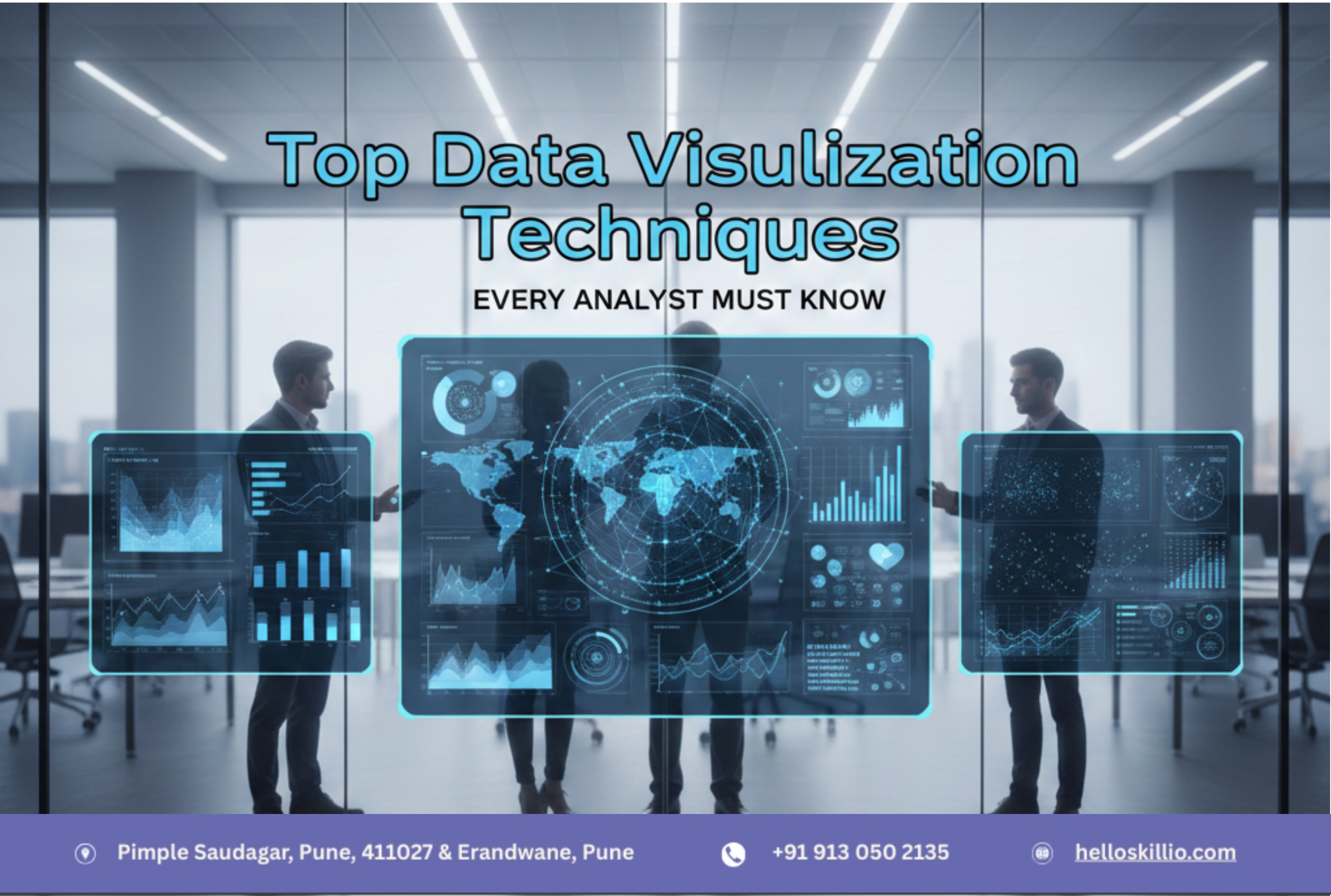
In today’s data-driven world, data visualization plays a critical role in turning complex datasets into meaningful insights. For data analysts, the ability to present data clearly and effectively is just as important as analyzing it. The right visualization helps stakeholders understand trends, patterns, and outliers quickly—leading to better decision-making.
In this blog, we explore the top data visualization techniques every analyst must know and when to use them.
1. Bar Charts
Bar charts are one of the most commonly used visualization techniques. They are ideal for comparing values across different categories.
Best used for:
Comparing sales across regions
Showing performance metrics
Category-based comparisons
Why analysts use it:
Bar charts are easy to read and interpret, making them perfect for business reports and dashboards.
2. Line Charts
Line charts are used to visualize trends over time and show how values change continuously.
Best used for:
Time-series data
Stock prices
Website traffic over months or years
Why analysts use it:
They clearly highlight upward or downward trends, helping identify growth patterns and seasonality.
3. Pie Charts
Pie charts represent proportions and percentages of a whole.
Best used for:
Market share analysis
Budget distribution
Percentage breakdowns
Why analysts use it:
When used with limited categories, pie charts make it easy to understand relative contributions.
4. Scatter Plots
Scatter plots show the relationship between two numerical variables.
Best used for:
Identifying correlations
Detecting outliers
Analyzing relationships between variables
Why analysts use it:
They help reveal patterns, clusters, and correlations that might not be visible in tables.
5. Heat Maps
Heat maps use color intensity to represent values in a dataset.
Best used for:
Correlation matrices
Website user behavior
Performance tracking across metrics
Why analysts use it:
They allow quick identification of high and low values, making large datasets easier to analyze.
6. Histograms
Histograms show the distribution of a single numerical variable.
Best used for:
Understanding data distribution
Identifying skewness
Analyzing frequency ranges
Why analysts use it:
They help analysts understand how data is spread and where most values lie.
7. Box Plots
Box plots summarize data using quartiles and show outliers clearly.
Best used for:
Comparing distributions
Identifying outliers
Statistical analysis
Why analysts use it:
They provide a compact view of variability and central tendency.
8. Area Charts
Area charts are similar to line charts but filled with color below the line.
Best used for:
Showing cumulative totals over time
Comparing multiple trends
Why analysts use it:
They emphasize volume and trends simultaneously.
9. Dashboards
Dashboards combine multiple visualizations into a single interactive view.
Best used for:
Business intelligence reporting
KPI tracking
Executive summaries
Why analysts use it:
Dashboards provide a real-time overview of performance and support quick decision-making.
10. Interactive Visualizations
Interactive charts allow users to filter, drill down, and explore data.
Best used for:
Advanced analytics
Business intelligence tools like Power BI or Tableau
Large datasets
Why analysts use it:
Interactivity improves user engagement and deeper insight discovery.
Tools Commonly Used for Data Visualization
Tableau
Power BI
Excel
Python (Matplotlib, Seaborn, Plotly)
R (ggplot2)
Learning these tools enhances an analyst’s ability to create impactful visual stories.
Conclusion
Mastering data visualization is essential for every data analyst. Choosing the right visualization technique ensures your insights are clear, accurate, and actionable. By understanding when and how to use each visualization, analysts can communicate data effectively and influence better business decisions.
Whether you’re a beginner or an experienced professional, improving your data visualization skills will significantly boost your value in today’s analytics-driven industry.
Top Data Visualization Techniques Every Analyst Must Know explores the most effective ways to transform complex data into clear, actionable insights. Brought to you by Data Analytics Classes in Pune by Skillio, this guide covers essential visualization techniques such as bar charts, line graphs, scatter plots, heat maps, dashboards, and interactive visualizations used by modern data analysts.
Designed for beginners and aspiring professionals, this article explains when and why to use each visualization method to improve data interpretation, storytelling, and decision-making. Learn how mastering data visualization tools and techniques can enhance your analytical skills and boost your career in data analytics.
At Skillio, we focus on practical, industry-relevant data analytics training that prepares you for real-world analytics roles.